Cover letters for software engineering jobs: when and how to write one
Write a cover letter when the employer asks for one or when your application needs context a resume cannot give, such as a career change or a gap. Keep it to one page: name the role, connect one specific piece of your experience to something the job actually needs, and close plainly. Do not repeat your resume or use a template unchanged.
About 6 min read
Decide whether it is worth writing
Write a cover letter when the employer asks for one, when the form has a field for it, or when your application needs context the resume cannot supply: a career change, a gap, a relocation, or an unusual fit for this specific role. When the posting does not mention one, most tech recruiters skip it, and a generic letter adds nothing.
The test is whether you have something specific to say. If every sentence could attach to any job at any company, leave the field empty rather than sending filler. A skipped optional letter hurts less than a bland one.
A structure that fits on one page
First paragraph: name the role and where you saw it, in one or two sentences. Skip the flattery opening; recruiters have read every version of it.
Middle: one piece of evidence, not a summary of the resume. Pick the requirement in the posting you match best and describe the specific work that proves it: what you built, your part in it, and the result. Then one sentence connecting it to this job, so the link is explicit rather than implied.
Close plainly: availability or visa/logistics only if relevant, then a simple sign-off. No 'I would love to discuss' boilerplate paragraph.
This is a leaner version of the classic five-part letter (header, introduction, evidence, fit, closing) that We Work Remotely lays out. For most tech roles the header and the culture-fit paragraph can stay minimal: what survives is the evidence and the explicit connection.
- One page maximum; three short paragraphs is normal.
- Mirror one or two terms from the posting only where they are true of you.
- Every claim should survive a follow-up question in an interview.
Reference: We Work Remotely: What a cover letter should look like
A worked example and a downloadable sample
The sample below is for a fictional backend engineer applying to a platform role. Notice what it does not do: it does not open with enthusiasm, does not retell the resume, and does not claim the company is a dream employer. It picks one posting requirement and answers it with evidence. Adapt the structure; the content is fictional. The PDF and plain-text downloads are in the practice panel below.
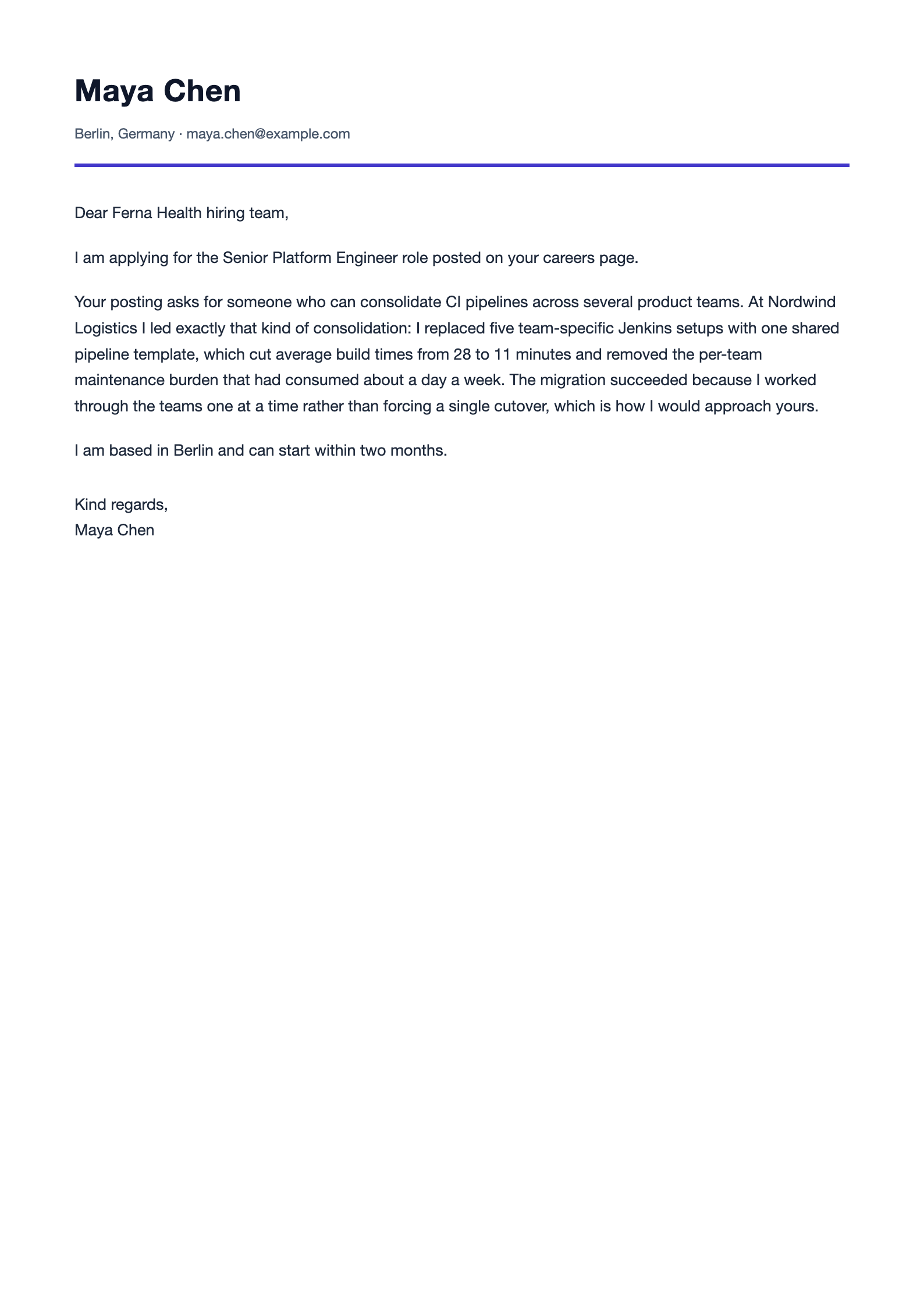
Maya Chen Berlin, Germany maya.chen@example.com Dear Ferna Health hiring team, I am applying for the Senior Platform Engineer role posted on your careers page. Your posting asks for someone who can consolidate CI pipelines across several product teams. At Nordwind Logistics I led exactly that kind of consolidation: I replaced five team-specific Jenkins setups with one shared pipeline template, which cut average build times from 28 to 11 minutes and removed the per-team maintenance burden that had consumed about a day a week. The migration succeeded because I worked through the teams one at a time rather than forcing a single cutover, which is how I would approach yours. I am based in Berlin and can start within two months. Kind regards, Maya Chen
For remote roles, the letter does extra work
A remote hiring manager never watches you work. Your letter doubles as a writing sample and as the only evidence that you can operate without daily supervision, so it needs to show independence rather than claim it. One specific example of something you carried end to end with minimal oversight beats three 'self-starter' adjectives.
Two more remote signals are cheap to include when they are true: async habits (shared docs, recorded updates, written handoffs) and time-zone experience, stated plainly in one line. If your remote history is thin, freelance work and self-managed projects count; describe the habit, not the job title.
Reference: We Work Remotely: A cover letter for a remote job should show you can work independently
Tailor it in minutes, not hours
A sustainable process matters because a letter is only worth writing for roles where you have something specific to say. Read the posting and pick the one requirement you match best. Write three sentences about the evidence, one connecting it to this job, and stop. If a posting gives you nothing to anchor to, that is information: either the role is generic or you are stretching for a fit.
Keep the header, contact line, and sign-off identical across applications so the only work per letter is the middle. Twenty minutes of specific tailoring beats an evening spent rephrasing the same generic paragraphs.
Mistakes that waste the letter
Restating the resume in prose is the most common waste: the recruiter already has it. Using one letter unchanged for twenty applications is the second; if the company name is the only thing that changed, the reader can tell. Claims you cannot support in an interview are the third and the most dangerous, because the letter becomes the first thing they probe.
Two smaller habits round it out. Do not address a named person you have not confirmed; a team or hiring-team greeting is safer than a guessed title. And do not apologise for applying: lines like 'I know I lack direct experience in this field' hand the reader a reason to stop before your evidence arrives. Name the gap in your own terms only when you can immediately answer it.
Frequently asked questions
Is a cover letter expected for tech jobs?
Usually not unless the posting or form asks for one. Some startups and most traditional companies read them; many tech recruiters skip them. When in doubt, spend the effort on a resume that parses and a specific application.
Should the letter repeat my resume?
No. Pick the single strongest match to the posting and explain it. The letter's job is context and motivation, not a second copy of your history.
Can I use AI to draft it?
You can use a draft as a starting point, but check every claim and rewrite it in your own words. Generic AI phrasing is recognisable, and an invented accomplishment can surface again at interview.
How long should it be?
One page maximum; three short paragraphs is normal. Recruiters spend seconds on it, so the first two sentences carry most of the weight.
Practise the next answer
If you write a cover letter, the claims in it become interview material. Paste the job post and your resume into PrepRole and run a Recruiter Screen: the AI Interviewer will ask about exactly the kind of motivation and evidence the letter asserts. Rehearse saying it before you send it.
Sources and scope
Employer sources describe their own processes, which may change. The exercises and illustrative examples are PrepRole editorial guidance, not employer questions or hiring criteria.
Related guides
AI feedback can be wrong. A practice Verdict is not a hiring decision.